Technical work simulations

A workday that reveals how someone works.

Candidates complete a realistic final assessment with role-specific tools and working context. Your hiring team receives the work, check results, and source-linked findings across software engineering, data & analytics, ML engineering, and ML research, then makes its own decision.

Inside the simulation

Four disciplines.
A real piece of the job.

Investigate an assignment, use the tools, and clarify requirements with AI coworkers. Explore an example from each role area.

ML research

Reproduce a research claim within a compute budget

Illustrative scenario
01 / Workbench

reproduce.py · illustrative excerpt

# Match conditions before comparing methods.
for seed in [11, 23, 37]:
    config = ExperimentConfig(
        seed=seed, steps=1200,
        dataset="fixed_split_v1"
    )
    baseline = run("baseline", config)
    method = run("proposed", config)
    log_pair(seed, baseline, method)

# Report all runs, including failed attempts.
write_report(results, compute_budget)
02 / Team conversation
Research lead · AI coworker

Does this paper’s improvement hold under our compute budget, and is the method worth pursuing?

Candidate

I’ll match the baseline conditions, record every run, examine variability, and recommend the most informative next experiment.

Example dialogue showing how working context enters the task.
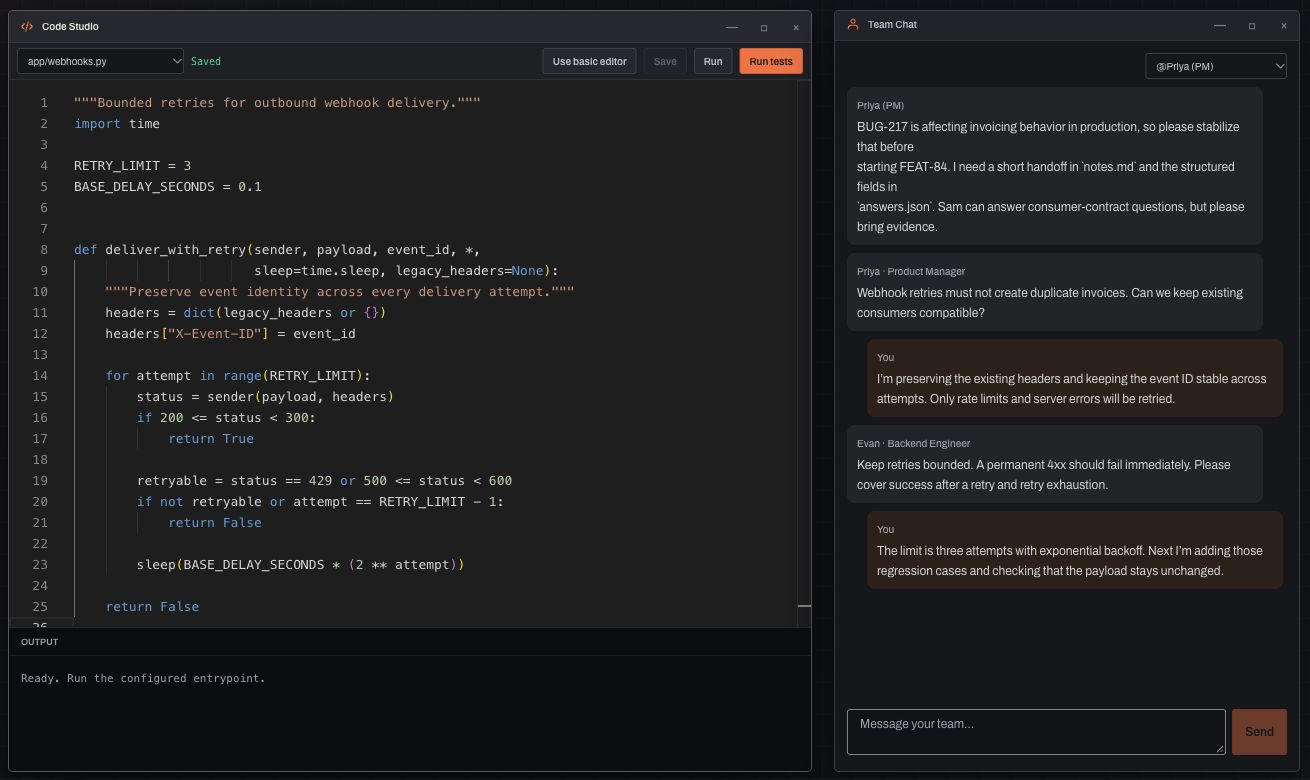
See the actual simulation interface Software example · code & team chat
The candidate workspaceActual interface / demo content
Actual SeeTheWork workspace showing Python webhook retry code beside a team conversation about compatibility and regression cases.
Actual interface · illustrative demo code and conversationThe task and enabled tools vary by role.
Enlarged actual Code Studio showing Python retry logic.
Code Studio · scroll to inspect the full code
Enlarged actual Team Chat discussing compatibility, retry limits, and verification.
Team Chat · clarify and explain decisions

The process

A final assessment with a clear human handoff.

Choose a meaningful piece of the job, set consistent conditions, then review the evidence as a team. Follow-up can help when a question remains.

  1. 01

    Shape the simulation

    SeeTheWork drafts the task and review criteria. Your hiring manager supplies role context, checks realism, and agrees on the tools and conditions for a final assessment.

    Starting point
    A role brief and the work your final assessment should reveal
    Review output
    One approved assessment with consistent conditions
  2. 02

    Candidate does the work

    A real participant completes a roughly 90-minute assessment with realistic tasks, tools, and working context. The time limit and tool policy are agreed for the role before the session.

    Starting point
    An agreed task, participant scope, and session instructions
    Review output
    Finished work and the relevant working context
  3. 03

    Make a human hiring decision

    Your technical reviewer inspects the work and checks, challenges the summary, and identifies any useful follow-up. Your hiring team considers the evidence and makes the decision.

    Starting point
    Completed work and captured evidence
    Review output
    A review package for an accountable human decision

Two clear views

The candidate does the task. Your team reviews the work.

A short public walkthrough demonstrates the flow. A real pilot uses an agreed assessment session and its own candidate instructions.

Try the scripted 3-minute walkthrough
Candidate sees

Task and working context

Role-relevant instructions, available tools, and the task conditions agreed with your team. Real participant sessions are designed around 90 minutes.

Hiring team receives

Work with inspectable evidence

Candidate-produced artifacts, objective check results, source-linked findings, visible uncertainty, and possible follow-up questions.

The review package

A brief with sources you can inspect.

Reviewers can scan the summary or inspect the work behind it. Missing and uncertain evidence stays visible.

Explore all four evidence briefs
Finished work
The artifact or change the candidate produced.
Objective checks
Tests and task-specific results that can be verified directly.
Working context
Relevant decisions and evidence linked back to the work.
Human review
Reviewer notes, uncertainty, and the next questions to ask.

Start with one role and the work your final assessment should reveal.

Discuss a pilot